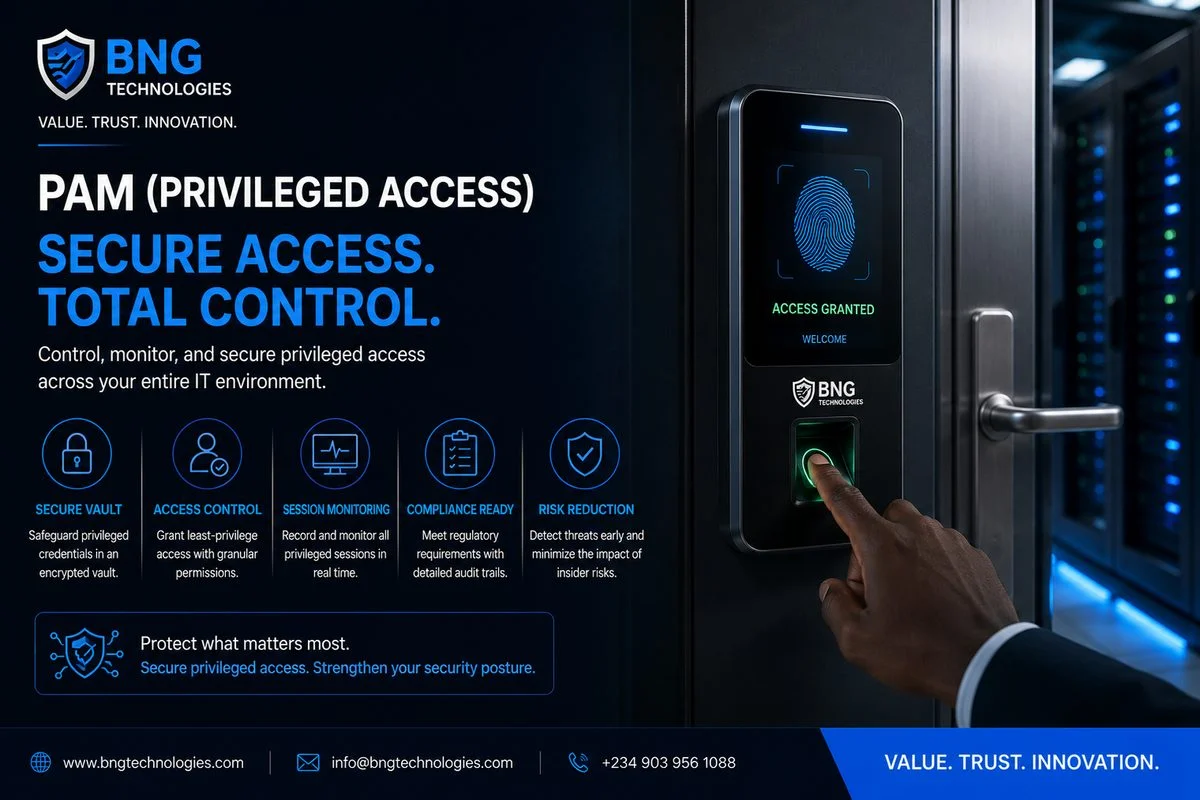
Ask any incident response team what they find at the centre of a serious breach, and the answer is almost always the same: a compromised privileged account. Domain admin credentials stolen through phishing. A service account with excessive permissions exploited by malware. A contractor's account left active months after the engagement ended.
Privileged Access Management (PAM) is the discipline — and the technology — that controls, monitors, and audits access to your most sensitive systems and accounts. And despite being one of the most effective security controls available, it remains one of the most commonly skipped in Nigerian and African enterprises.
This article explains what PAM is, why it matters, and how to implement it practically — without grinding your IT operations to a halt.
What Is a Privileged Account?
A privileged account is any account with elevated permissions beyond those of a standard user. This includes:
- Domain administrator accounts — with control over your entire Active Directory environment
- Local administrator accounts — on individual servers and workstations
- Service accounts — used by applications and automated processes to communicate with each other
- Database administrator accounts — with read/write access to your core business data
- Cloud console root accounts — such as AWS root or Azure Global Administrator
- Network device accounts — on routers, switches, and firewalls
In many organisations, these accounts are shared between multiple engineers, their passwords rarely changed, and their activity never audited. That is an enormous attack surface — and attackers know it.
By the numbers: Verizon's 2024 Data Breach Investigations Report found that 77% of breaches involving hacking used stolen or brute-forced credentials. The majority targeted privileged accounts specifically — because one compromised admin account can unlock an entire organisation.
The Core Problem: Privilege Sprawl
In most Nigerian enterprises we engage with, privileged access has grown organically over years — without a clear policy, without a record of who has what, and without any process for revoking access when it is no longer needed. We call this privilege sprawl.
How Privilege Sprawl Happens
An engineer is given domain admin rights to complete a project. The project ends but the rights remain. A vendor is given local admin access to configure a system. Three years later, that vendor's account is still active. An application is deployed with a service account that has domain admin privileges because it was "easier" than scoping the exact permissions needed.
Multiply this across a five-year IT history and you have hundreds of accounts with excessive privileges — most of them unmonitored, many of them forgotten, some of them already compromised without anyone knowing.
The principle of least privilege: Every account should have the minimum permissions needed to perform its function — nothing more. This is a foundational security principle that PAM enforces at scale.
What PAM Actually Does
A PAM solution addresses privileged access across four core functions:
1. Privileged Account Discovery
PAM tools scan your environment to find every privileged account — including service accounts and local admin accounts that your IT team may not even know exist. This discovery phase alone is often eye-opening for organisations that have never conducted a formal access review.
2. Credential Vaulting
Privileged passwords are stored in an encrypted vault. Engineers do not know the passwords — they request access through the PAM system, which checks out a credential on their behalf and checks it back in when the session ends. Passwords are rotated automatically after every use. This eliminates shared passwords, credential theft via shoulder-surfing, and the risk of a departed employee retaining access.
3. Session Recording and Monitoring
Every privileged session is recorded — keystrokes, commands, screen activity. If a privileged account is used to exfiltrate data, delete records, or make unauthorised configuration changes, you have a complete audit trail. This is invaluable for forensic investigation and is increasingly required by regulators.
4. Just-in-Time Access
Rather than leaving privileged accounts permanently enabled, PAM solutions can provision access on demand — for a specific time window, for a specific system — and revoke it automatically when the window closes. An engineer who needs domain admin rights to perform a server migration gets them for two hours, then loses them. The account does not exist as a persistent attack surface.
PAM in the Nigerian Enterprise Context
Several factors make PAM particularly relevant for Nigerian and West African organisations right now.
Regulatory Pressure Is Increasing
The Central Bank of Nigeria's cybersecurity framework requires financial institutions to implement controls over privileged access. The NDPR demands that organisations protecting personal data implement appropriate access controls. PAM directly satisfies both requirements — and provides the audit logs to demonstrate compliance.
Third-Party and Vendor Risk
Nigerian enterprises frequently engage vendors and contractors who require remote access to internal systems — for support, maintenance, and project delivery. Managing that access without a PAM solution means creating accounts that may never be properly revoked, or sharing credentials that may be compromised at the vendor's end. PAM allows you to grant vendors time-limited, session-recorded access without exposing your credentials.
The Insider Threat Is Real
Economic pressures in the Nigerian environment create elevated insider threat risk. A disgruntled IT administrator with unchecked domain admin rights can cause catastrophic damage — wiping backups, exfiltrating customer data, or locking the organisation out of its own systems. PAM limits what any individual can do, and ensures everything they do is recorded.
A common scenario we encounter: An organisation discovers that a former IT contractor — who left 18 months ago — still has active domain admin credentials. Those credentials have been used intermittently. No one noticed because there was no privileged session monitoring in place. This is not unusual. It is the norm.
Implementation: Where to Start
PAM implementation does not need to be a multi-year programme. A phased approach can deliver significant risk reduction within weeks.
Phase 1: Discover and Inventory (Week 1–2)
Run a privileged account discovery scan across your Active Directory, servers, databases, and network devices. Document every privileged account, its purpose, its owner, and whether it is still needed. This inventory is the foundation of everything that follows.
Phase 2: Vault Your Tier-0 Accounts (Weeks 2–4)
Start with your most sensitive accounts — domain admins, cloud console root accounts, and database admin accounts. Onboard these to the PAM vault immediately. Rotate all passwords. From this point forward, no engineer accesses these accounts directly.
Phase 3: Enable Session Recording (Weeks 3–5)
Turn on session recording for all privileged sessions. This has an immediate deterrent effect — engineers know their activity is being recorded — and provides the audit trail required for regulatory compliance.
Phase 4: Broaden Coverage and Automate (Months 2–4)
Expand vaulting to service accounts, local admin accounts, and vendor accounts. Implement just-in-time access for accounts that are only needed occasionally. Integrate with your SIEM for real-time alerting on anomalous privileged activity.
PAM Vendors Worth Knowing
The enterprise PAM market has several strong vendors. The right choice depends on your existing environment and budget:
- CyberArk — the market leader for enterprise PAM; deep feature set, strongest for complex environments
- BeyondTrust — strong on remote vendor access and endpoint privilege management
- Delinea (formerly Thycotic/Centrify) — more accessible for mid-market organisations; cloud-native options
- Microsoft Entra PIM — built into Microsoft 365/Azure AD; a good starting point if you are a Microsoft shop, particularly for just-in-time Azure role assignments
The Bottom Line
Privileged accounts are the keys to your kingdom. In most Nigerian enterprises, those keys are poorly tracked, widely shared, and almost never audited. A single compromised privileged account can render every other security control you have invested in irrelevant.
PAM is not glamorous security technology. It does not have the marketing budget of a next-generation firewall vendor. But ask any security professional which single control would most reduce their risk of a catastrophic breach — and PAM is almost always the answer.
BNG Technologies helps organisations implement PAM solutions right-sized for their environment — from Microsoft Entra PIM for Microsoft-centric mid-market organisations to full enterprise PAM deployments. If you would like a privileged access assessment or are ready to start an implementation, contact our security team.
Ready to take control of privileged access?
Our security engineers will assess your privileged account exposure and design a PAM programme that fits your organisation.