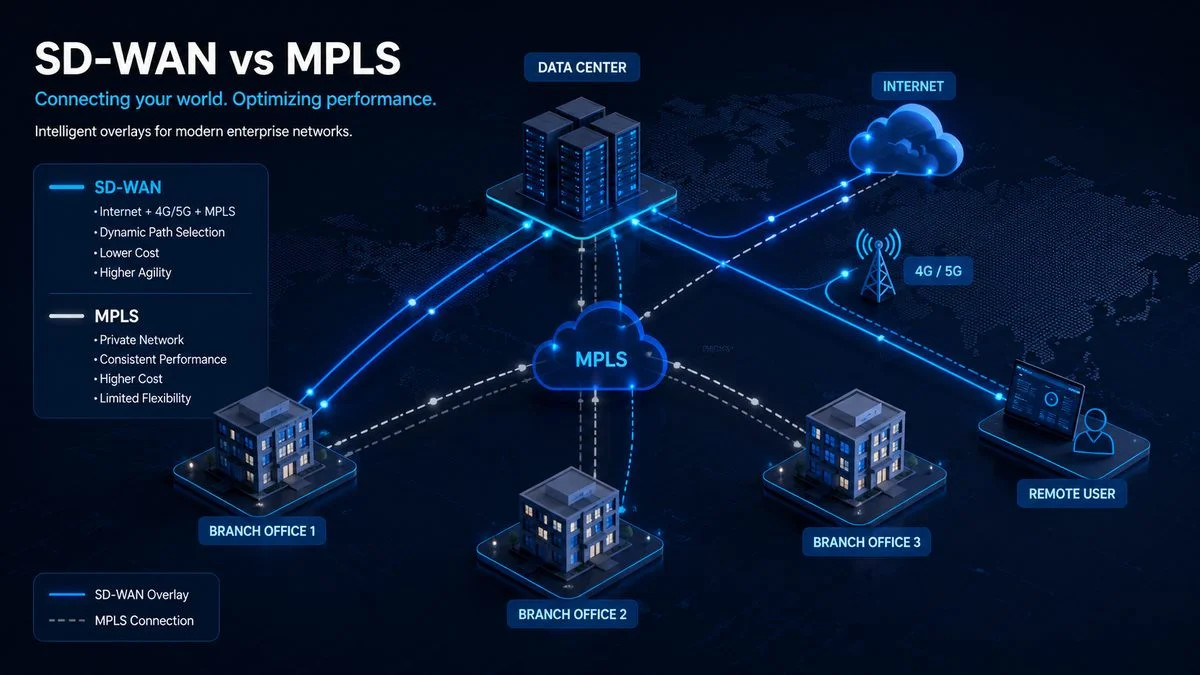
If you manage a multi-site enterprise network in Nigeria or across Africa, you have almost certainly been asked — or are asking yourself — whether to move from MPLS to SD-WAN. The conversations happening in boardrooms and IT departments across Lagos, Abuja, Accra, and Nairobi are all variations on the same theme: SD-WAN is cheaper, more flexible, and better for cloud. Why are we still paying for MPLS?
The answer, as with most things in enterprise networking, is more nuanced than the sales pitch suggests. This article gives you the honest comparison — the real trade-offs, not the vendor narrative — so you can make the right decision for your organisation.
What Each Technology Actually Is
MPLS (Multiprotocol Label Switching)
MPLS is a private, managed WAN service delivered by a carrier. Traffic is routed across a dedicated private network — separate from the public internet — using predefined label-switched paths. The carrier guarantees performance: specific bandwidth, latency, jitter, and packet loss commitments are written into the SLA.
MPLS is expensive because it is scarce — the carrier is allocating dedicated network capacity to you. It is also slow to provision: circuit delivery in Nigeria typically takes 4–12 weeks, and changes take even longer.
SD-WAN (Software-Defined Wide Area Network)
SD-WAN is not a transport technology — it is an overlay that runs on top of whatever underlying connections you have (broadband internet, 4G/5G, MPLS, or any combination). A centralised controller manages traffic routing intelligently across all available links, selecting the best path for each application based on real-time performance metrics.
The key SD-WAN value proposition: use cheap internet bandwidth to achieve near-MPLS performance, with full cloud optimisation built in, at a fraction of the cost.
Side-by-Side Comparison
| Factor | MPLS | SD-WAN |
|---|---|---|
| Cost | High — premium carrier pricing, per-Mbps rates | Low — runs on broadband/LTE; carrier-agnostic |
| Performance | Guaranteed SLA: latency, jitter, packet loss | Best-effort; intelligent path selection mitigates issues |
| Cloud Optimisation | Poor — backhauling cloud traffic adds latency | Excellent — direct breakout to cloud at each site |
| Security | Inherently private — traffic never touches internet | Requires additional security stack (NGFW, SASE) |
| Agility | Slow — weeks to provision, changes require carrier | Fast — new sites in hours, policy changes in minutes |
| Visibility | Limited — carrier manages the network | Full — centralised dashboard, per-application analytics |
| Resilience | Single carrier dependency | Multi-link failover, sub-second switchover |
| Scalability | Expensive and slow to scale | Highly scalable — add sites, bandwidth on demand |
Where MPLS Still Wins
Despite the SD-WAN momentum, there are specific scenarios where MPLS remains the better — or necessary — choice:
Real-Time, Latency-Sensitive Applications
If your business runs real-time voice (VoIP), video conferencing, or trading platforms that are genuinely sensitive to jitter and packet loss, MPLS's guaranteed performance characteristics still have an edge. SD-WAN's intelligent routing is good, but it cannot guarantee performance on links it does not control.
Highly Regulated Environments
Some regulated environments — CBN-regulated financial institutions, certain government agencies — have explicit requirements that certain data categories not traverse the public internet. For these use cases, MPLS (or a hybrid approach where sensitive traffic stays on MPLS) may be required regardless of the economic argument.
Remote Locations with No Broadband Alternative
In parts of Nigeria and across sub-Saharan Africa, quality broadband internet simply isn't available at some branch locations. In these cases, MPLS — or 4G/5G with SD-WAN overlay — may be the only viable WAN option.
The African context matters: Internet reliability varies significantly across regions. In Lagos and Abuja, multiple broadband providers give SD-WAN the diverse connectivity it needs to work well. In secondary cities and across borders, quality can be inconsistent. Your WAN strategy should reflect your actual footprint, not a generic best practice.
Where SD-WAN Clearly Wins
Cloud-First Organisations
If your staff spend significant time in Microsoft 365, Google Workspace, Salesforce, or other SaaS platforms, backhauling their traffic through a central MPLS hub adds unnecessary latency. SD-WAN with direct cloud breakout at each site dramatically improves the user experience for cloud applications — often the biggest productivity win in an SD-WAN migration.
Multi-Site Expansion
Adding a new branch on MPLS means waiting weeks for the carrier to provision a circuit. On SD-WAN, a new site can be connected in hours using whatever broadband is available locally — a zero-touch provisioning device ships to the site, plugs into the internet connection, and calls home to the controller. The operational difference is transformative for fast-growing organisations.
Cost Reduction at Scale
For an organisation with 10+ sites, the cost difference between MPLS and SD-WAN over broadband is substantial. Typical Nigerian enterprise MPLS costs range from ₦600,000 to ₦750,000+ per site per month depending on bandwidth. Equivalent broadband links for SD-WAN are a fraction of that — with the savings funding the SD-WAN platform itself and then some.
Visibility and Control
SD-WAN platforms — Cisco Viptela, Fortinet SD-WAN, Palo Alto Prisma SD-WAN — provide application-level visibility across every site from a single pane of glass. You can see which applications are consuming bandwidth at each branch, enforce QoS policies centrally, and troubleshoot in real time. MPLS gives you none of this by default.
The Hybrid Approach: Best of Both
For most large Nigerian enterprises, the answer is neither full MPLS nor full SD-WAN — it is a hybrid model:
Recommended Hybrid Architecture
- Retain MPLS for your highest-priority, most latency-sensitive traffic between headquarters and critical data centres
- Deploy SD-WAN overlay to manage traffic intelligently across MPLS + broadband links
- Migrate branch offices to broadband-only with SD-WAN as confidence and link quality permits
- Use direct internet breakout at branches for cloud and SaaS traffic
- Layer a security stack (NGFW or SASE) at each breakout point to maintain control
This approach allows you to reduce MPLS spend progressively — transitioning sites as broadband quality improves and as your team builds confidence in the SD-WAN platform — without making a risky all-at-once migration.
Security: The SD-WAN Caveat You Need to Hear
SD-WAN opens up your network perimeter in ways MPLS does not. When branch traffic breaks out directly to the internet rather than going through a centralised security stack, each breakout point becomes an attack surface.
This is not a reason to avoid SD-WAN — it is a reason to plan your security architecture alongside your WAN architecture. Every SD-WAN deployment should include:
- Next-generation firewall (NGFW) at each branch breakout point — either an on-box security stack (Fortinet FortiGate SD-WAN has this integrated) or a cloud-delivered security service (SASE)
- DNS filtering to block malicious domains before connections are established
- Centralised policy management so security rules are consistent across all sites
- Encrypted tunnels between all SD-WAN nodes — all major SD-WAN platforms do this by default
Our recommendation: If you are evaluating SD-WAN platforms, Fortinet's integrated approach — where the SD-WAN and security functions run on the same FortiGate appliance — is particularly well-suited to African deployments where you may not have IT staff at every branch site.
Making the Decision
The right answer depends on your specific environment. Before committing to either technology, assess:
- What are your sites? How many, where, and what broadband options exist at each?
- What are your applications? What latency and reliability do they actually need?
- What is your cloud posture? How much of your traffic is SaaS vs. on-premise?
- What are your compliance requirements? Are there regulatory restrictions on internet routing for any data?
- What is your team's capability? SD-WAN adds operational complexity — do you have the skills in-house or will you need managed services?
BNG Technologies designs and deploys SD-WAN and hybrid WAN solutions for Nigerian and African enterprises, drawing on certified expertise across Cisco, Fortinet, and Juniper Mist. We can assess your current WAN architecture, model the cost and performance trade-offs for your specific environment, and deploy whichever solution best fits your needs.
Evaluating your WAN options?
Our network engineers can assess your current environment and model the right WAN architecture for your footprint and applications.