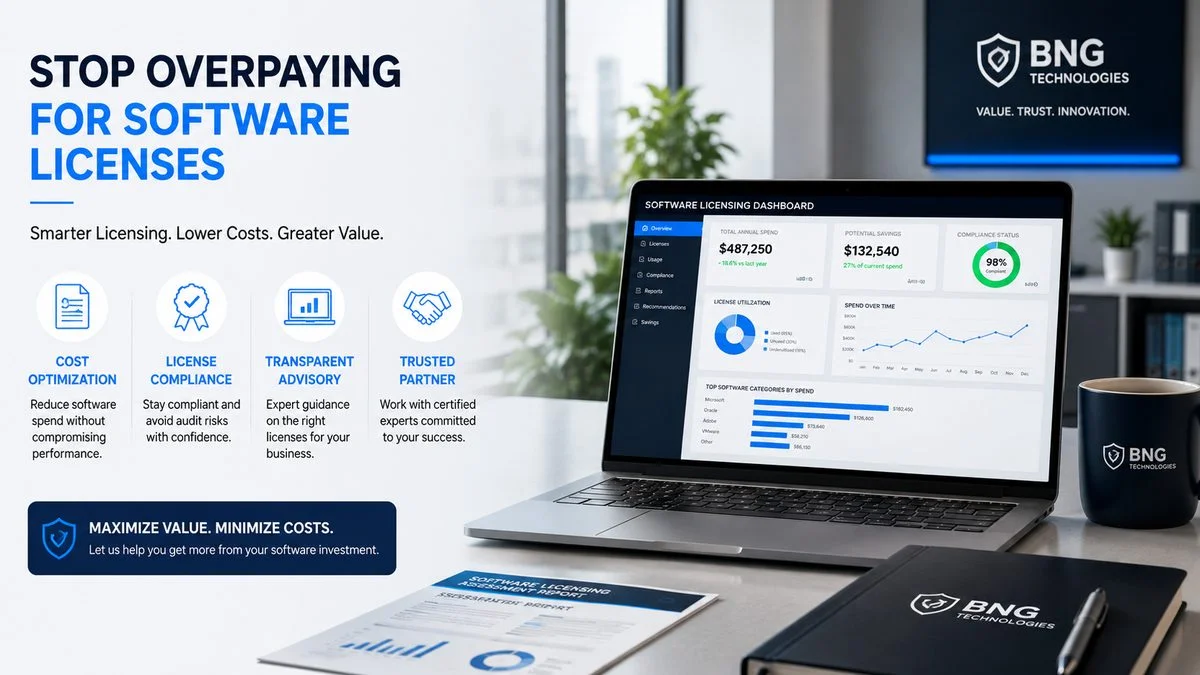
Software licensing is one of the largest IT budget line items for most enterprises — and one of the least understood. Vendors have engineered their licensing models to be deliberately complex, with metrics that shift, entitlements that expire, and renewal cycles that quietly lock you in at escalating rates.
The result: the average Nigerian enterprise is paying significantly more than necessary for software they partially use, under agreements they don't fully understand, renewed on terms that favour the vendor.
This is fixable. Here's how.
Why Organisations Overpay
License Sprawl
Over time, software estates grow organically — departments buy tools independently, pilots never get decommissioned, and headcount changes don't trigger license reductions. A 500-person organisation may be paying for 650 seats of a productivity suite because nobody tracked attrition, offboarding, or role changes against the license count.
Auto-Renewals at List Price
Most enterprise software agreements auto-renew. Vendors rely on procurement teams being too busy — or unaware — to renegotiate at renewal. List price is almost never the right price. Vendors have significant flexibility, but they will not offer it unless you ask — and unless you ask at the right time.
Wrong License Tier or Metric
Enterprise licensing metrics are complex: per user, per device, per core, per socket, per virtual machine, concurrent users, named users. Choosing the wrong metric for your actual usage pattern can result in paying for capacity you can't use, or being unexpectedly non-compliant. This is particularly common with database software (Oracle, SQL Server) and virtualisation platforms.
Maintenance You Don't Need
Annual maintenance and support contracts are a significant revenue stream for software vendors — typically 18–22% of licence value per year. But many organisations are paying for maintenance on software they no longer actively use, or for support tiers (e.g., 24/7 enterprise support) that are excessive for their actual usage pattern.
True-Up Surprises
Enterprise Agreements with true-up provisions require you to report actual usage periodically and pay for any overage. Organisations that don't track usage carefully find themselves with unexpected true-up bills that can run to hundreds of thousands of naira — or more.
The most common scenario we see: A Nigerian bank or telecoms company renews its Microsoft EA at auto-renewal pricing, with the same seat count as three years ago, without reviewing which M365 plan features are actually being used or whether the mix of E3 vs. E5 licences matches current needs. Savings of 15–25% are usually achievable with a proper review.
The Microsoft Licensing Opportunity
Microsoft is the largest software spend for most Nigerian enterprises, so it deserves specific attention. Common optimisation opportunities:
Right-Sizing M365 Plans
Microsoft 365 comes in multiple tiers — Business Basic, Business Standard, E1, E3, E5 — with significant price differences. Many organisations default to one plan for all users, when in reality different user groups have different needs. A mixed licensing approach — E3 for power users, F3 (Frontline) for non-desk workers, and Business Basic for light users — can reduce per-user costs substantially without reducing capability for anyone.
Azure Hybrid Benefit
If you have existing Windows Server or SQL Server licences with active Software Assurance, Azure Hybrid Benefit allows you to use those licences on Azure VMs, significantly reducing your Azure compute costs. Many organisations with Azure deployments are not claiming this benefit.
EA Negotiation Timing
Microsoft's financial year ends in June. Enterprise Agreement negotiations in April–June typically yield better commercial outcomes, as Microsoft's sales teams are under maximum pressure to close revenue. If your EA renews at another time of year, it's worth asking whether a term adjustment is possible to align with this window.
Unused Features
Microsoft 365 E5 includes advanced security features (Microsoft Defender, Purview, Intune) that many organisations pay for but never activate. Conversely, some organisations buy E3 and then separately procure security tools that are already included in E5 — paying twice for the same capability.
Cisco Smart Licensing
Cisco's transition to Smart Licensing has created confusion — and unexpected compliance gaps — for many organisations. Key issues to address:
- Entitlement reconciliation: Are your registered Cisco devices consuming the right licence tiers? Devices operating outside their licenced entitlement create both compliance risk and support gaps.
- SWSS (Software Support Services): Review whether active Software Support contracts are held for devices actually in production. Lapsed SWSS means no software updates and no TAC support — a significant security and operational risk.
- ELA (Enterprise License Agreement) consideration: For organisations with large Cisco estates, a Cisco ELA can provide significant savings versus per-device licensing, with the flexibility to add products within the agreement scope.
How to Conduct a License Audit
License Audit Process
- Inventory all software in use — both centrally procured and shadow IT (use network discovery tools to find unlicensed installations)
- Map licences to actual users — identify inactive accounts, ex-employees with active entitlements, and unused allocations
- Review all maintenance and support contracts — identify software on maintenance that is no longer in active use
- Audit your M365 and Azure usage — pull utilisation reports from the Microsoft Admin Centre and Azure Cost Management
- Check Cisco device entitlements against your Smart Account in Cisco Software Central
- Identify upcoming renewal dates — build a 12-month calendar so you negotiate proactively rather than at the last minute
- Request usage data from vendors — most enterprise agreements entitle you to usage reports; use them
- Benchmark your pricing — compare your current rates against published partner pricing and market rates
Negotiating Better Terms
The most important principle in software licence negotiation: never renew without negotiating. Vendors expect you to negotiate — list price exists as an anchor, not a final offer.
Use Competitive Alternatives
Even if you have no intention of switching, introducing a competitive alternative into a negotiation changes the dynamic. Microsoft knows you are evaluating Google Workspace. Oracle knows you are looking at PostgreSQL. This is not deception — it is legitimate procurement practice, and it works.
Bundle and Consolidate
Vendors reward consolidation. If you are buying five products from Microsoft, negotiate them as a bundle — the volume commitment justifies better pricing. Conversely, if a vendor is trying to sell you a bundle with products you don't need, disaggregate and price each component separately.
Negotiate the Term
Three-year agreements typically achieve better pricing than one-year, but lock you in longer. For stable, strategic platforms (Microsoft, Cisco core networking) a 3-year term is usually rational. For emerging technologies where your requirements may change, maintain flexibility with shorter terms.
Engage an Authorised Partner
Working through an authorised reseller like BNG Technologies — rather than direct with the vendor — gives you access to partner pricing, which is typically 15–40% below list price depending on the product and volume. Partners also have relationships with vendor sales teams that can unlock additional commercial flexibility.
Bottom line: A structured licence optimisation exercise typically yields savings of 15–35% on your software spend. For an organisation spending ₦50 million annually on software licences, that is ₦7.5–17.5 million back in your IT budget — available for infrastructure, security, or headcount.
Getting Started
The first step is visibility. Most organisations don't have a single, accurate view of what software they have, what they're paying for it, and whether they're compliant. A Software Asset Management (SAM) engagement closes that gap — typically in four to six weeks — and produces a prioritised list of optimisation actions.
BNG Technologies provides licence advisory and procurement services across Microsoft, Cisco, Fortinet, VMware, and the broader enterprise software stack. As an authorised partner for all major vendors, we can source licences at partner pricing and help you structure agreements that give you flexibility, compliance, and value.
Want to reduce your software spend?
We'll review your current licences, identify overspend, and source replacements at authorised partner pricing — typically saving 15–35%.