The cloud-first mandate that swept through enterprise IT over the past decade was, in many ways, a correction. Organisations that had accumulated decades of on-premise infrastructure — much of it underutilised, poorly managed, and difficult to scale — needed a forcing function to modernise. "Move everything to cloud" was that forcing function.
But the pendulum has swung. Cloud repatriation — moving workloads back from public cloud to on-premise or co-location facilities — is now a measurable trend. Not because cloud was wrong, but because "cloud everything" was never the right strategy. The maturation of enterprise cloud thinking has arrived at a more nuanced position: put each workload where it belongs.
For Nigerian enterprises specifically, that nuanced position almost always resolves to a hybrid model — and Microsoft Azure provides the most complete set of tools to make hybrid work in practice.
Why Pure Cloud Is Harder in Nigeria
Nigerian enterprises face connectivity constraints that make pure cloud architectures more challenging than they are in Europe or North America. This is not a reason to avoid cloud — it is a reason to be deliberate about which workloads move there.
Latency to Azure Regions
Microsoft has data centre regions in South Africa (Johannesburg and Cape Town) and is expanding into other African markets, but for many Nigerian enterprises, the nearest Azure region is South Africa North. Round-trip latency from Lagos to Johannesburg is typically 50–80ms. For many applications, this is imperceptible. For latency-sensitive workloads — core banking real-time transaction processing, manufacturing execution systems, high-frequency trading — it is material.
International Bandwidth Cost and Reliability
International bandwidth in Nigeria, while improving, is more expensive and less reliable than in Western markets. Applications that generate high data volumes between on-premise systems and cloud — large database synchronisation, high-resolution video processing, large-scale file sharing — may generate egress costs that erode the economic case for cloud hosting.
Regulatory and Data Residency Requirements
Some workloads — particularly in financial services under CBN regulation — have data residency requirements that restrict where customer data can be stored. Understanding these requirements before designing your cloud architecture is essential. Azure's compliance documentation for South Africa regions is well-developed, but the specifics depend on your sector and the nature of the data.
The practical implication: These constraints do not eliminate the case for Azure. They define which workloads are best suited for cloud hosting and which are better served by modern on-premise infrastructure. The answer is different for every organisation — and it changes over time as connectivity improves and Azure expands its African footprint.
What Hybrid Azure Actually Looks Like
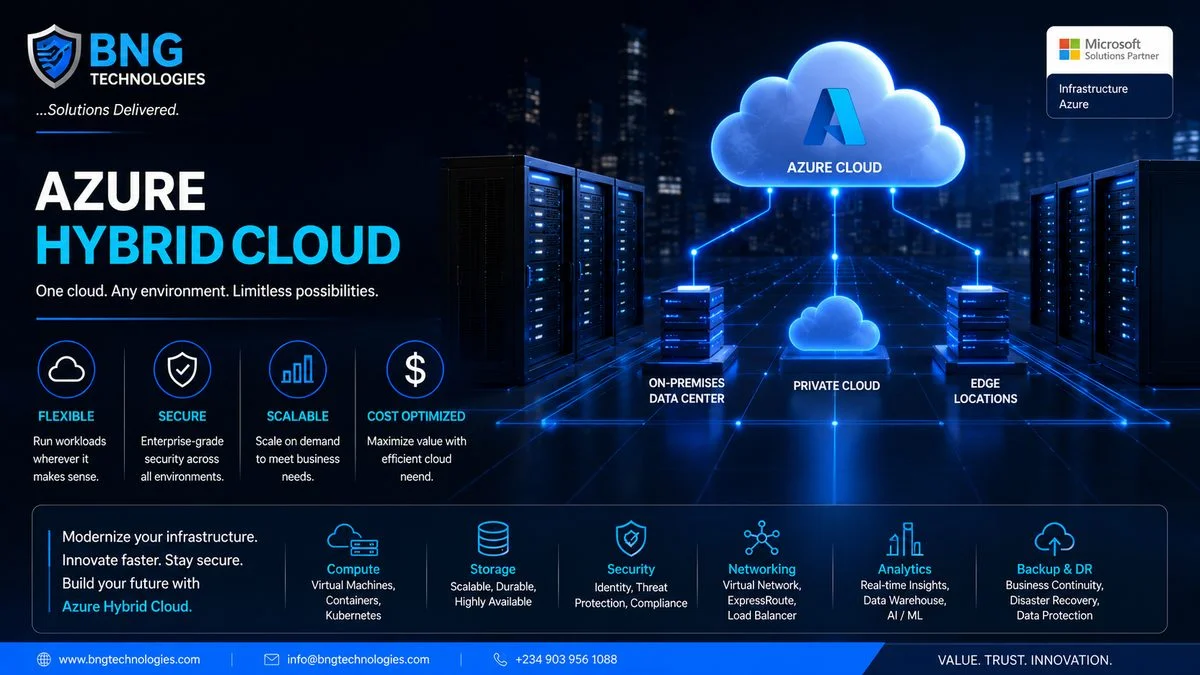
A hybrid Azure architecture connects your on-premise infrastructure to Azure in a way that allows workloads to run in either environment while appearing to users and applications as a coherent, unified platform. The key components are:
Azure Arc: Extending Azure Management On-Premise
Azure Arc is Microsoft's hybrid management platform. It allows you to manage on-premise servers, Kubernetes clusters, and databases through the Azure portal — applying Azure policies, security baselines, and monitoring to infrastructure that physically sits in your data centre. This is particularly valuable for organisations that want Azure's governance capabilities without moving workloads to the cloud.
Azure AD / Entra ID: Unified Identity
Identity is the foundation of any hybrid architecture. Azure Active Directory (now Microsoft Entra ID) provides a single identity plane that spans on-premise Active Directory (through AD Connect) and cloud resources. Users authenticate once and access resources in both environments seamlessly. Conditional Access policies enforce security requirements regardless of where the resource lives.
ExpressRoute: Dedicated Private Connectivity
For organisations with significant data transfer between on-premise and Azure, Site-to-Site VPN over the public internet may not provide sufficient bandwidth or reliability. Azure ExpressRoute provides a private, dedicated connection to Azure — bypassing the public internet entirely. In the Nigerian context, ExpressRoute can be provisioned through several peering providers, including those with Points of Presence in Lagos.
Azure Backup and Site Recovery
One of the most compelling hybrid use cases is using Azure as a DR target. Azure Backup provides cloud-based backup for on-premise workloads. Azure Site Recovery replicates on-premise virtual machines to Azure and can fail over to cloud in the event of a primary site outage. For organisations without a viable secondary data centre, this can be more cost-effective than maintaining physical DR infrastructure.
The Workload Decision Framework
The core of hybrid cloud strategy is deciding, for each workload, where it should run. This decision should be made on objective criteria, not on default assumptions.
Move to Azure when
- The workload is not latency-sensitive and can tolerate 50–80ms round-trip to South Africa North
- Demand is variable and cloud elasticity (scale up/down) has genuine value
- The workload is available as SaaS (Microsoft 365, Dynamics 365, Teams) — avoid running commodity apps on IaaS when SaaS exists
- The workload is dev/test — cloud is ideal for environments that only need to run intermittently
- The application vendor has a cloud-hosted version with better support than on-premise
Keep on-premise when
- The workload has genuine latency requirements that cloud connectivity cannot satisfy
- Data residency or regulatory requirements prevent cloud hosting
- The workload generates data volumes where egress costs make cloud uneconomic
- The workload is tightly coupled to physical infrastructure (manufacturing equipment, specialist hardware)
- Existing licensing makes on-premise significantly cheaper than cloud equivalents
Microsoft 365: The Gateway Drug
For most Nigerian enterprises, the hybrid Azure journey starts with Microsoft 365 — email, Teams, SharePoint, OneDrive. This is low-risk, high-value, and provides immediate benefit: professional collaboration tools available to every user, managed by Microsoft, with no on-premise infrastructure to maintain.
More importantly, Microsoft 365 establishes Entra ID as the identity foundation. Once identity is in the cloud, adding other cloud workloads — Azure IaaS, cloud-hosted applications, third-party SaaS — becomes significantly simpler. The identity infrastructure is already there.
Common mistake: Migrating to Microsoft 365 for email but continuing to run SharePoint on-premise, or continuing to use a separate identity provider. This creates a fragmented identity estate that is harder to secure and more expensive to manage. Do the migration properly — one identity, one management plane.
Security in a Hybrid Environment
Hybrid architectures expand your attack surface. An on-premise environment that was previously isolated is now connected to the internet via Azure, and any misconfiguration in that connectivity is exploitable. Security must be designed into the hybrid architecture from the start, not added afterwards.
The key security controls for a hybrid Azure environment are:
- Microsoft Defender for Cloud — unified security posture management across on-premise and Azure workloads; identifies misconfigurations, missing patches, and compliance gaps
- Azure Firewall / Fortinet in Azure — network security at the Azure perimeter; controls what traffic can flow between on-premise and cloud environments
- Conditional Access policies — enforce MFA, device compliance, and location-based access requirements for all cloud resource access
- Microsoft Sentinel — cloud-native SIEM that aggregates logs from both on-premise and Azure, providing unified threat detection across the hybrid estate
- Private Endpoints — ensure Azure services are accessible only from your private network, not from the public internet
Cost Management: Where Hybrid Gets Complicated
Cloud costs are variable and can escalate quickly without active management. Azure provides Cost Management tools, but they require configuration and ongoing attention. The organisations that consistently overspend on cloud are those that treat provisioning as a one-time activity and forget about the running costs.
Practical cost management in a hybrid Azure environment involves: right-sizing VMs based on actual utilisation data (not estimated requirements), using Reserved Instances for workloads with predictable demand (typically 40–60% cheaper than pay-as-you-go), implementing auto-scaling for workloads with variable demand, and setting budget alerts that notify before costs exceed thresholds.
The Bottom Line
Azure hybrid cloud is not a compromise — it is the architecture that most Nigerian enterprises with mature IT operations are moving towards. It provides the agility of cloud where cloud makes sense, the control and performance of on-premise where that matters, and a unified management and security plane across both.
Getting there requires careful workload assessment, proper identity architecture, secure connectivity design, and active cost management. Done well, it reduces infrastructure management overhead, improves resilience, and provides a platform that scales with the business.
BNG Technologies is a Microsoft partner with certified expertise in Azure hybrid architecture, Microsoft 365 deployment, and Azure security. If you are planning a cloud migration or want to assess your current hybrid posture, contact our cloud team.
Planning a move to Azure?
Our Microsoft-certified engineers can assess your workloads, design your hybrid architecture, and manage the migration — end to end.