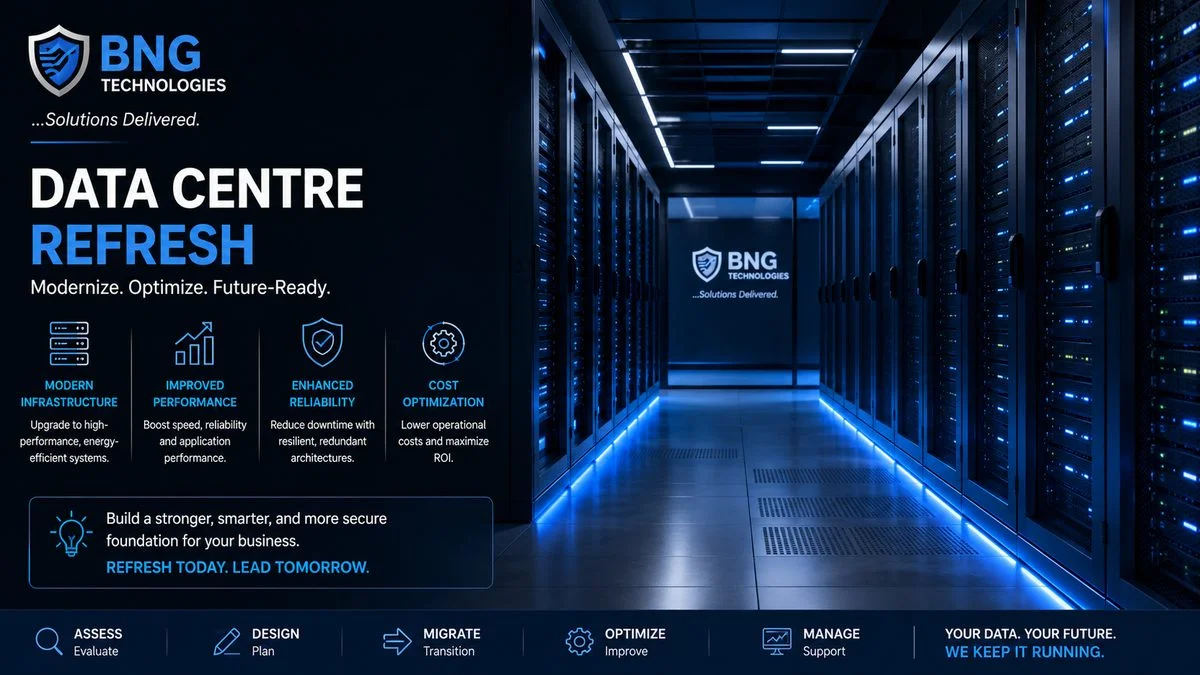
Most Nigerian enterprises running their own data centres are operating on hardware that is four to eight years old. Servers beyond their end-of-life date. Storage arrays with no vendor support. Network switches running firmware that has not been patched in two years. UPS systems with batteries that have never been tested under real load.
This is not neglect — it is the outcome of a rational decision-making process in environments where capital budgets are constrained and the pressure to "keep it running" outweighs the pressure to "do it properly." But the risks compound over time, and eventually the cost of a failure — planned or unplanned — exceeds the cost of the refresh by a significant margin.
The question organisations face when they reach that point is not just "what hardware do we need?" It is "what is the right architecture for the next five to seven years?" That question has three possible answers: upgrade in place, consolidate into fewer, better-specified facilities, or migrate to cloud. Most realistic answers involve some combination of all three.
Diagnosing the Problem First
Before deciding what to do, you need to understand what you have. A data centre refresh begins with an asset audit that goes beyond inventory — it assesses the business risk associated with what you are running today.
Questions your audit should answer
- Which systems are past vendor end-of-life, and are they still receiving security patches?
- What is the actual utilisation of your compute and storage capacity? (Most enterprise environments are 15–30% utilised on average.)
- Which workloads have genuine dependencies on on-premise infrastructure versus which are running on-premise purely by default?
- What is your current RPO and RTO for critical systems, and does your infrastructure actually support it?
- When was your last DR test, and did you recover within the documented timeframe?
- What is the power and cooling capacity of your data centre, and how much headroom remains?
The answers to these questions determine which of the three paths makes sense for each workload — and which workloads are most urgent.
Option 1: Upgrade In Place
For organisations with existing data centre facilities, on-premise regulatory requirements (some financial institutions and government organisations have data residency mandates), or workloads with genuine latency or data volume constraints that make cloud connectivity impractical, upgrading in place is the right approach.
The modern on-premise data centre looks very different from the one most Nigerian enterprises are currently running. The shift to hyperconverged infrastructure (HCI) — platforms like Nutanix, VMware vSAN, or Pure Storage FlashStack — eliminates the traditional three-tier compute/storage/network architecture and replaces it with software-defined infrastructure running on commodity hardware. The result: dramatically higher density, simpler management, and linear scalability.
What a Modern On-Premise Refresh Typically Involves
- Compute virtualisation — consolidating physical servers onto a smaller number of modern hypervisor hosts running VMware, Nutanix AOS, or Microsoft Hyper-V
- All-flash storage — replacing spinning disk arrays with NVMe flash storage; the performance delta is an order of magnitude, and the power and cooling savings often offset a significant portion of the cost
- Software-defined networking — micro-segmentation of workloads, eliminating the flat internal network that allows lateral movement in a security incident
- Backup and replication modernisation — replacing tape or aging backup solutions with modern platforms (Cohesity, Veeam, Commvault) that support immutable backups, fast recovery, and cloud tiering
From recent experience: A client running 40 physical servers at 18% average utilisation consolidated to 6 Nutanix nodes at 65% utilisation. Power consumption dropped by 60%. Rack space freed up allowed the data centre to be right-sized into a smaller footprint. The hardware cost was recovered in under 24 months through power and maintenance savings alone.
Option 2: Consolidation
Many Nigerian enterprises have data centre infrastructure spread across multiple locations — a primary DC, a DR site, and often a collection of server rooms in regional offices that have accumulated over years of organic growth. Each site has its own hardware, its own management overhead, and its own power and cooling costs.
Consolidation — typically into a primary DC and a single DR site, with branch offices connecting to centralised infrastructure — reduces management complexity, eliminates duplicated licensing, and concentrates your skilled IT staff on fewer, better-managed facilities.
Consolidation works well in combination with a hybrid cloud approach: consolidate on-premise workloads into fewer facilities, and use cloud for DR, burst capacity, and workloads with variable demand.
Option 3: Cloud Migration
The "cloud-first" narrative of the past decade has been useful but often oversimplified. Not every workload belongs in the cloud. But many workloads that are currently running on-premise in Nigerian enterprise data centres would be better served by cloud — and the barrier to recognising this is usually inertia, not a genuine technical constraint.
Workloads that are strong candidates for cloud migration include:
- Development and test environments — which only need to run during business hours and consume resources intermittently
- Collaboration and productivity platforms — Microsoft 365, email, SharePoint — most organisations that have not already migrated these should do so
- ERP and CRM platforms — many are now available as SaaS, eliminating the infrastructure layer entirely
- Backup and archive — cloud storage is cost-effective for cold data that needs to be retained for compliance purposes
- Web-facing applications — which benefit from cloud elasticity, CDN integration, and not requiring on-premise DMZ architecture
What typically stays on-premise: Core banking systems, real-time trading platforms, manufacturing execution systems, and other latency-sensitive or data-intensive workloads where cloud connectivity introduces unacceptable lag or egress costs. The decision should be made workload by workload, not as a blanket policy.
The Hybrid Answer
For most Nigerian enterprises, the right answer is a hybrid architecture: a modernised, right-sized on-premise core for workloads that genuinely belong there, combined with cloud for everything else. This is not a compromise — it is the architecture that most mature global enterprises have arrived at after years of experience.
The key to making hybrid work is connectivity. Your on-premise infrastructure and cloud environments need to behave as a single, coherent platform — with consistent identity (Azure AD / Entra ID), consistent security policy, and consistent management tooling across both. This is the domain where implementation expertise matters most, and where organisations that attempt it without experienced guidance encounter the most problems.
Sequencing the Refresh
A data centre refresh is a multi-year programme, not a single project. Getting the sequencing right determines whether it proceeds smoothly or generates months of disruption.
- Stabilise first — address the highest-risk items immediately: replace failed or failing hardware, patch critical vulnerabilities, test your backup recovery process
- Migrate the easy wins — move collaboration tools, dev/test environments, and archive data to cloud first; these are low-risk migrations with immediate cost benefit
- Consolidate and modernise on-premise — replace ageing three-tier infrastructure with HCI; right-size your server room or data centre footprint
- Address DR and replication — once your primary infrastructure is modernised, ensure your DR posture is tested and meets your documented RTO/RPO
- Optimise — once the new architecture is stable, focus on cost optimisation (cloud Reserved Instances, storage tiering, right-sizing) and operational improvements (monitoring, automation)
The Bottom Line
There is no single correct answer to "upgrade, consolidate, or cloud?" The right answer depends on your workloads, your regulatory constraints, your connectivity quality, and your team's capability to manage the resulting architecture. What is certain is that doing nothing is the most expensive option of all — the risk of an unplanned failure on ageing infrastructure almost always exceeds the cost of the refresh.
BNG Technologies helps Nigerian enterprises assess, plan, and execute data centre refresh programmes — from initial audit through hardware procurement, virtualisation, cloud migration, and ongoing managed support. If your infrastructure is overdue for a rethink, start with a conversation.
Time to assess your infrastructure?
Our engineers will audit your current environment and give you a clear picture of risk, options, and realistic costs — no obligation.